

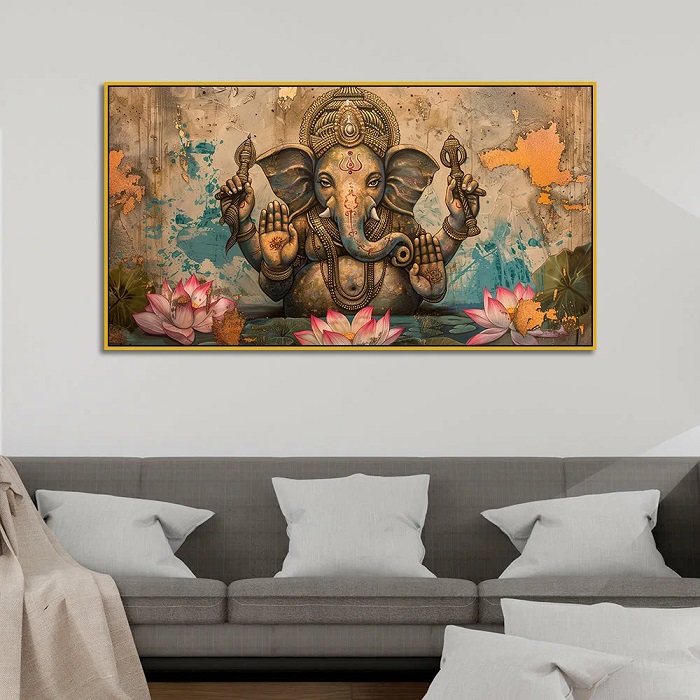
Choosing wall art with a clear meaning can make decorating more direct. Instead of starting with color alone, you begin with a symbol and let the room follow. A Buddha canvas print, a mantra art print, or a Ganesha canvas can act as a steady focal point in a living room, bedroom, home office, or entryway. These themes also fit modern decor because they rely on recognizable forms: a figure, an emblem, or text. When the message is easy to read, you can scale the piece up for large wall art or keep it compact for a smaller wall.
This post compares three related options from Artesty: a Buddha-themed canvas print, an Om Mani Padme Hum mantra canvas, and a Ganesha wall art canvas. You will learn what each symbol communicates, how to choose size and panel layout, where to hang the piece at home or at the office, and what to look for in print construction so the canvas sits cleanly on the wall.
What these symbols communicate in a room
Buddha imagery
Buddha imagery is often chosen for rooms that support quiet routines: morning tea, journaling, breathing practice, or a short meditation. In decor terms, Buddha wall art usually reads as calm and structured. The figure gives the eye a place to rest, which can reduce visual noise when the rest of the room has shelves, screens, or layered textiles. If your room already has strong lines or high-contrast furniture, a Buddha canvas can balance the space by adding a centered subject that holds the wall without competing with everything around it.
Om Mani Padme Hum as mantra wall art
Text-based canvas art works differently than figure-based artwork. A mantra print carries meaning through letters and layout, so it can work well in minimalist wall decor where open space matters. Many buyers use mantra wall hangings as a daily cue: you see the phrase as you pass through the room, and it becomes part of a routine. Mantra wall art can also pair with other canvas prints because it provides a clean visual break between images, helping a gallery wall feel organized rather than crowded.
Ganesha imagery
Ganesha imagery is often selected for areas tied to learning, planning, and new projects. In a room, Ganesha wall art can feel purposeful and welcoming, which makes it suitable near a desk, in an office, or in an entryway. Because the form stays readable from a distance, it can also work for large canvas prints that need to remain clear across a wide wall.
How to choose the right canvas print for your wall
Start with the role the art will play
Before choosing a size, decide what the canvas should do in the room. Is it the main focal point above a sofa, or a supporting piece beside a bookshelf? Are you building a single statement wall art setup, or a small group of art prints that share one theme? Answering these questions narrows your options quickly.
- Focal point: Choose a larger canvas print or a multi-panel layout so the subject anchors the wall.
- Supporting piece: Choose a medium size and leave more open wall around it.
- Routine reminder: Consider a mantra wall print placed at eye level near the path you walk each day.
Pick the panel layout
Artesty canvas prints are available in different panel formats. A single-panel canvas is a direct choice when you want centered symmetry. Multi-panel wall art (such as 3 panels or 5 panels) can suit wider walls, especially behind furniture that spans most of the wall. A multi-panel arrangement also adds rhythm because the gaps between panels create structure without adding more decor items. If your wall already has strong elements (lighting, shelves, or large furniture), a single panel may keep the wall calmer.
Choose the size with a simple measuring method
Use a tape measure and painter’s tape to outline the planned canvas size on the wall. Step back to your usual viewing distance and check whether the subject stays readable. For living room wall decor, a practical approach is to size the artwork to cover a substantial portion of the furniture width while leaving clear space at the sides. For a bedroom, a slightly smaller width can work if your goal is a quieter wall rather than a statement wall.
- Measure the wall width and the furniture width (if the canvas will hang above furniture).
- Mark the proposed canvas width on the wall using painter’s tape.
- Check sightlines from the doorway, seating, and the main path through the room.
- Adjust up or down until the canvas feels proportional without crowding nearby objects.
Three spiritual wall art options (product spotlights)
Buddha canvas print for a calm focal wall
If you want a clear figure-based centerpiece, start with the Buddha canvas print wall art. A Buddha painting on canvas often suits spaces where you want one stable visual anchor. In a living room, it can sit above a sofa as the main wall decor element. In a bedroom, it can work on the wall opposite the bed so the room keeps a quiet center without adding extra objects. If you prefer a cleaner look, keep nearby decor minimal and let the canvas art carry the wall.
Om Mani Padme Hum mantra canvas art for routine-based decor
For a symbol-and-text approach, the Om Mani Padme Hum mantra canvas print is a strong choice. Because it is text-forward, it works well with clean lines and modern room decor. Many buyers place mantra canvas art near a doorway, beside a desk, or along a hallway so the message sits within everyday movement. It can also pair with other wall art prints: use the mantra as a visual pause between image-based pieces, or place it as the center point of a small gallery wall.
Ganesha wall art canvas for study and office walls
If your room is built around focus and planning, consider the Ganesha canvas print wall art. Ganesha imagery can work well above a desk or on a side wall in a home office, where the subject remains visible but does not compete with screen work. In an entryway, it can define the first wall you see, especially when the wall is otherwise open and needs one clear artwork choice. If you are choosing between a single panel and multi-panel canvas, use a single panel for a tighter wall and multi-panel for a wide wall that needs more coverage.
What to look for in print construction
When you buy a canvas print online, construction details matter because they affect how the piece sits on the wall over time. Across Artesty product pages, the production specifications include: 380 GSM, 100% cotton canvas; UV-protective coating; archival pigment ink; hand-stretched corners; mirrored edges; and a dried pinewood framework about 1.5 inches (3 cm) wide. These details support clear print detail, a stable stretched surface, and a ready-to-hang wall decor format.
Two practical checks help buyers choose with confidence. First, confirm the canvas format: a gallery wrapped canvas print is designed to look finished without an outer frame. Second, confirm edge treatment: mirrored edges can help the front image remain intact on the visible face of the artwork, even when the sides wrap around the frame.
Placement ideas for home and office
Use room function to choose placement. A canvas print that supports quiet routines should be placed where your attention naturally slows down. A canvas that supports planning can sit where you work or where you set intentions for the day. Keep the artwork at a comfortable viewing height, and avoid placing it where doors, chair backs, or daily traffic will bump the surface.
- Living room: Above the sofa as a focal wall art piece, or on a side wall near a reading chair.
- Bedroom: On the wall opposite the bed, or near a dressing area where the room stays uncluttered.
- Home office: Behind the desk for a clean background, or on a side wall to reduce screen dominance.
- Hallway or entryway: A single-panel statement canvas to define the first wall you see.
- Kitchen or dining room: Only if the wall stays away from direct splash zones; keep it high enough to avoid contact.
Pairing with other wall art prints
If you are building a small gallery wall, keep the theme consistent: figure-based images together, text-based prints together, or one figure canvas paired with one text canvas for contrast. Use the same canvas depth across the set so the wall reads as one system rather than separate pieces. If you want to browse more related themes without leaving the spiritual category, start with Religious wall art and canvas prints and then narrow by subject and panel layout.
Care and display tips
Light and viewing comfort
Hang the canvas where lighting is even across the day, if possible. If the wall receives strong daylight, placing the artwork on a nearby wall with softer light can reduce glare and make the image easier to view. Keep a small gap between the canvas and nearby furniture so the edges stay protected during daily use.
Cleaning
For routine care, dust the surface gently with a soft, dry cloth. Avoid wet cleaning and avoid household cleaners. If the canvas is near a workspace where dust collects quickly, a quick weekly dusting helps the wall decor stay clean and crisp.
FAQ: Buddha, mantra, and Ganesha wall art
1) What is the simplest way to choose between Buddha and Ganesha wall art?
Choose Buddha imagery for quiet routines and calm. Choose Ganesha imagery for study, planning, and new projects.
2) Is mantra wall art only for minimalist rooms?
No. A mantra canvas print can also work in layered decor because text can balance patterns with structure.
3) Should I pick a single-panel canvas or a multi-panel layout?
Pick a single panel for centered symmetry and narrower walls. Pick multi-panel wall art for wider walls.
4) How high should I hang a canvas print?
Keep the center near eye level for standing viewers. Adjust based on seating height and wall height.
5) How do I size wall art above a sofa?
Use painter’s tape to test width. Keep clear space on both sides so the wall does not feel crowded.
6) Can I mix spiritual canvas prints with abstract wall art?
Yes. Keep one consistent element such as spacing, canvas depth, or a shared color range.
7) What does “gallery wrapped” mean?
It means the canvas is stretched over a frame, with the image continuing around the sides for a finished look.
8) What do “mirrored edges” mean?
It means edge treatment that keeps the main front composition intact while the sides wrap around the frame.
9) What is archival pigment ink?
It refers to ink intended for long-term display with stable print detail.
10) Does UV-protective coating matter indoors?
It can matter in rooms with strong daylight, especially near windows where exposure accumulates over time.
11) Where does a mantra canvas print work well?
Hallways, entryways, beside a desk, or near a reading corner—places you pass daily.
12) Can I hang spiritual wall decor in an office?
Yes. Use a background wall or side wall, and keep the area tidy so the artwork reads clearly.
13) What if my wall is narrow?
Choose a smaller canvas print or a single-panel layout, and leave more open wall around it.
14) How do I keep a gallery wall from looking messy?
Use consistent spacing, align centers, and limit the wall to one theme: figure, symbol, or text.
15) What is a practical first step before ordering?
Measure the wall, test the planned size with tape, then confirm lighting and daily traffic around that spot.
Closing thought
Wall decor works best when it supports how you use a room. Start with the symbol that matches your routine, choose a panel layout that suits your wall width, and select a canvas size that stays readable from your main viewing distance. With a clear plan, a canvas print becomes an intentional part of room decor.